What data provisioning means
Data provisioning is the process of making data available to the people and systems that need it. In software delivery, test data provisioning means giving development, QA, performance and AI teams data that is realistic enough to find defects, safe enough to hold in their environments and fresh enough to match current schemas.
It sits inside test data management: deciding what data each environment needs, producing it, refreshing it, and retiring it when it is no longer needed.
The trade-offs that decide your mix
- Realism vs exposure. The closer data is to production, the more defects it finds, and the more harm a leak from a test environment causes.
- Coverage vs volume. Production is large but repetitive. A small synthetic set built around edge cases can test more behaviour than a full copy.
- Freshness vs effort. Schemas change. Every refresh of a masked copy repeats the masking job; synthetic data needs its rules updated instead.
- Consistency across systems. A customer must match across the CRM, the core system and the documents attached to them. Masking each system separately breaks those links unless replacement is consistent.
- Ground truth. Only generated data comes with the right answers recorded, which matters when you score extraction or AI models rather than check that code runs.
For a deeper look at generating the data, see the synthetic test data generation guide; for masking tool categories, see data masking tools.
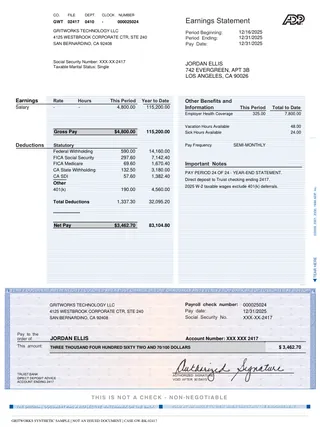
FREE SAMPLE PACK · BANKING
Try it with the free Banking sample pack.
Fictional documents, clean and degraded, with the expected value and position of selected populated fields.
10 PDFs · Checking statement, Paystub, W-2 and more · JSON and bounding boxes · CC BY 4.0
Free sample · No call required · No platform account
Need larger volumes, your own layouts or other formats? Talk to us ↗
Governance for test data provisioning
- Classify environments. Decide which environments may ever hold real personal data, and which may only hold masked or synthetic data.
- Approve requests. Record who asked for what data, for which purpose and for how long, and who approved it.
- Control access. Apply the same role-based access to test copies of sensitive data as to production.
- Expire and delete. Give every provisioned dataset a retention date, and remove copies when the project or test cycle ends.
- Keep evidence. Log refreshes, masking runs and deletions so you can show what data went where.
Data protection laws, such as India's DPDP Act (see the DPDP guide) and the GDPR, generally apply to personal data in test environments as much as in production. This is general information, not legal advice.
Where documents, PDFs and scans fit
Most provisioning plans cover databases and stop there. But loan files, claims, statements and identity documents sit alongside the records, and they carry the same personal data in a form column masking never touches.
- Real documents in test need their personal data removed from the text layer, the page image and the metadata before they move; the PII redaction guide explains how. GritRedact does this offline in your environment or as sales-assisted SaaS.
- Synthetic documents avoid the problem: fictional statements, forms and scans generated with known values and controlled degradations. GritRender generates documents, images and audio this way, and pricing is agreed with sales.
- Match documents to records. The customer on a synthetic bank statement should be the customer in your synthetic database, so end-to-end tests see consistent data.
To see what document test data looks like, browse the document types (for example bank statement OCR test data) or the free document dataset packs, such as the banking and loan pack. The packs are a testing resource, not a free tier.
What GritWorks does not replace
- GritWorks complements authorization, governance and e-discovery tools rather than replacing them. Access control, data catalogues, retention policy and legal review platforms keep their jobs; GritWorks prepares the documents, images and audio that move between them.
- Redaction is not authorization. If a person or system is not entitled to a record, block access instead of sending a redacted copy.
- Automated redaction alone is not a declaration of HIPAA de-identification. HIPAA recognizes the Safe Harbor and Expert Determination methods; policies, validation and human review must match the intended use and recipient.
- PII flagging is not redaction. GritTransform can flag potentially sensitive values in extracted results, but that does not remove them from the source. Use GritRedact when content must be removed.
- Engagement is sales-assisted. GritWorks has no public or self-serve API, SDK, MCP server or free tier, and publishes no price list: pricing is agreed with sales. Customer APIs are provided after onboarding.
Common questions
What is data provisioning?
Data provisioning is making data available to the people and systems that need it, in the right environment, at the right time and with the right controls. In software delivery it usually means test data provisioning for development, QA and AI teams.
What is test data provisioning?
Test data provisioning is supplying development, QA, performance and AI teams with data that is realistic enough to find defects, safe enough for their environments and current with production schemas, usually from production copies, masked copies, subsets or synthetic data.
Should we copy production data into test environments?
Only where the environment is controlled like production. Copies spread real personal data into places with wider access, carry no ground truth and are slow to refresh. Masked copies, subsets and synthetic data reduce that exposure.
What is the difference between data masking and data subsetting?
Masking replaces or obscures sensitive values in a copy. Subsetting takes a smaller, referentially intact slice of production. They are often combined: subset first to reduce volume, then mask what remains.
When is synthetic data the better choice for test data?
When you need edge cases production rarely has, ground truth for scoring, data for features that do not exist in production yet, or data you can share with vendors and offshore teams without exposing real people.
How do documents fit into test data provisioning?
PDFs, scans and images attached to records carry the same personal data, and column masking does not reach them. Redact real documents before they move, or use synthetic documents generated with known values that match your synthetic records.
FREE SAMPLE PACK · BANKING
Try it with the free Banking sample pack.
Fictional documents, clean and degraded, with the expected value and position of selected populated fields.
10 PDFs · Checking statement, Paystub, W-2 and more · JSON and bounding boxes · CC BY 4.0
Free sample · No call required · No platform account
Need larger volumes, your own layouts or other formats? Talk to us ↗
