The five sources of AI training data
- Collect. First-party data, such as product logs, documents customers submit and support transcripts, and data gathered from public sources. Cheap to acquire, expensive to make usable, and the rights depend on where it came from.
- License. Data bought from the organisation that holds it: publishers, archives, data marketplaces or companies with relevant records. Buying AI training data almost always means buying a license to use it, not ownership.
- Label. Paying people, in-house or through an annotation provider, to add the answers a model learns from: classes, spans, boxes, rankings or written demonstrations.
- Synthesize. Generating examples by rules, templates, simulations or models, with the labels recorded as the data is made.
- Redact real data. Removing personal or confidential information from data you already hold, so it can be used for a purpose its collection allows.
The sources combine. A common pattern: collected or licensed data for breadth, labels for the tasks that need them, synthetic data for rare cases and verifiable evaluation, and redacted real data to check that it all transfers.
What buying AI training data actually means
When you buy AI training data, read the license before the sample. Its terms decide what you can do with the data, and with the models you train on it.
- Permitted uses. Training, fine-tuning, evaluation, benchmarking and commercial deployment of the resulting model, or research only.
- Exclusivity. Whether the supplier can sell the same data to others, including your competitors.
- Term and deletion. How long the license lasts, and what happens to copies, derived datasets and trained models when it ends.
- Derivatives. Whether you may create and keep annotated, filtered or synthetic data derived from it.
- Warranties and indemnities. Whether the supplier stands behind its rights to the data, and how third-party claims are handled.
- Attribution and audit. Any credit the license requires, and whether either side can audit use.
Open licenses have terms too. CC BY 4.0, for example, allows commercial use with attribution, while other licenses forbid commercial use or derivatives. Check the license of every component, not only the dataset's headline license.
Questions to ask any AI training data company
Ask every supplier the same questions, including us, and get the answers in writing.
| Ask | A good answer includes |
|---|
| Provenance: where did every record come from? | A source for each component, collection dates and method, and a datasheet you can keep. |
|---|
| Consent: what did the people in the data agree to? | The consent or legal basis for this use, and how withdrawals are handled after delivery. |
|---|
| License: what may we do with the data and the models? | Written terms for training, evaluation, commercial deployment, exclusivity, term and what happens at the end. |
|---|
| PII handling: what personal data is in it? | What was removed or synthesized, how that was checked, and what risk remains. |
|---|
| Quality: how were labels produced and checked? | Annotation guidelines, agreement between annotators, and an audit of labels on a held-out sample. |
|---|
| Contamination: has this data appeared elsewhere? | Whether the data or its sources are public, sold to others or overlap known benchmarks, and how duplicates were removed. |
|---|
| Coverage: what is missing? | The mix of document types, languages, conditions and edge cases, including what the dataset does not cover. |
|---|
| Sample: can we test before we buy? | A representative sample under the same terms, large enough to run your own evaluation. |
|---|
Where synthetic documents fit, and their limits
Synthetic data is strongest where real data is scarce, sensitive or unlabeled. For documents that means:
- Exact ground truth. Field values and positions are recorded when each page is generated, so extraction can be scored, or rewarded, by code.
- Edge cases on purpose. Rare layouts, missing fields, handwriting, stamps, degraded captures and Indic scripts, included because a model needs them.
- No real people. Fictional records keep personal data out of training sets, logs and annotation queues.
And its limits:
- Generator bias. A model trained on one generator's output learns that generator's habits: its fonts, layouts and value distributions.
- The reality gap. Simulated blur, photocopy and fax approximate real capture devices but do not reproduce them.
- Nothing new about the world. A generator encodes what its designers knew; it cannot teach facts or formats it does not contain.
- Recursive training. Training mostly on model-generated text and images can narrow what models produce over generations, so keep real data in the mix.
Keep a real held-out set. Whatever the training mix, evaluate on real documents from your target distribution, with personal data removed, before trusting a gain measured on synthetic data. The RL environments guide covers how to keep eval sets out of training.
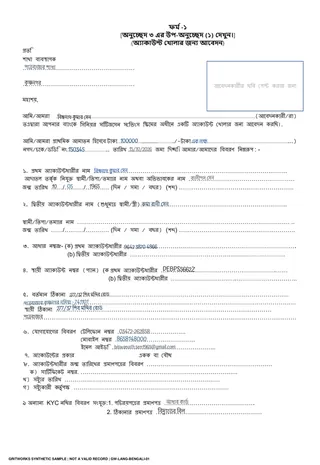
FREE SAMPLE PACK · INDIAN LANGUAGES
Try it with the free Indian Languages sample pack.
Fictional documents, clean and degraded, with the expected value and position of selected populated fields.
10 PDFs · Bengali savings form · A, Bengali savings form · B, Hindi savings form · A and more · JSON and bounding boxes · CC BY 4.0
Free sample · No call required · No platform account
Need larger volumes, your own layouts or other formats? Talk to us ↗
Using real documents you already hold
Many teams already hold the documents they need: forms, statements, claims and correspondence. Before they become training data:
- Check the purpose. Data collected to provide a service may not be usable for model training without a new legal basis or consent, depending on the law that applies.
- Remove personal data from every layer. The text layer, page image, handwriting, stamps, barcodes and metadata; see what redaction is and the PII redaction guide.
- Do not overclaim. Redacted data is not automatically anonymous; see what digitally anonymised means.
- Label what you keep. Real documents still need ground truth. Extraction tools can propose values, but people should verify them before they become labels.
Not legal advice
Not legal advice. Data licensing, copyright, privacy and AI rules differ by jurisdiction and change often. This guide is an educational summary prepared by GritWorks, a software company, not a law firm. Have counsel review licenses and the legal basis for using personal data before you train on it.
Sample documents and GritWorks
- The free document dataset packs are 10-PDF samples of fictional documents, five clean and five degraded, with structured JSON and bounding boxes for selected populated fields, licensed CC BY 4.0 (third-party marks excluded). Use them to try a pipeline or a grader; they are a testing resource, not a free tier, and not a complete training corpus.
- GritRender generates synthetic documents, images and audio with known values for training, testing and evaluation; GritRedact removes sensitive content from real documents; GritTransform extracts fields from PDFs and images into JSON. Each runs offline in your environment or as sales-assisted SaaS, and pricing is agreed with sales.
- For AI labs and data teams: document data for frontier AI labs.
What GritWorks does not replace
- GritWorks complements authorization, governance and e-discovery tools rather than replacing them. Access control, data catalogues, retention policy and legal review platforms keep their jobs; GritWorks prepares the documents, images and audio that move between them.
- Redaction is not authorization. If a person or system is not entitled to a record, block access instead of sending a redacted copy.
- Automated redaction alone is not a declaration of HIPAA de-identification. HIPAA recognizes the Safe Harbor and Expert Determination methods; policies, validation and human review must match the intended use and recipient.
- PII flagging is not redaction. GritTransform can flag potentially sensitive values in extracted results, but that does not remove them from the source. Use GritRedact when content must be removed.
- Engagement is sales-assisted. GritWorks has no public or self-serve API, SDK, MCP server or free tier, and publishes no price list: pricing is agreed with sales. Customer APIs are provided after onboarding.
Common questions
Where does AI training data come from?
From five sources: data you collect, data licensed from its owner, data labeled by people, synthetic data generated with its labels, and real data you already hold with personal information removed. Most training sets combine several.
Can you buy AI training data?
Yes, but usually you buy a license rather than the data itself. The license sets permitted uses, exclusivity, term, rights to derived data and models, and what happens when it ends, so read it before you evaluate samples.
What should you ask an AI training data company?
Where every record came from, what consent covers, what the license allows, how personal data was handled, how labels were produced and checked, whether the data has appeared elsewhere, what it does not cover, and for a sample to test.
Is synthetic data good enough to train AI models?
It helps where real data is scarce, sensitive or unlabeled, and it brings exact labels and controlled edge cases. It also carries generator bias and a gap to real capture conditions, so mix it with real data and evaluate on a real held-out set.
Is it legal to train AI on licensed or collected data?
It depends on the license, on copyright and privacy law where you operate, and on how the data was collected. This guide is not legal advice; have counsel review the terms and the legal basis before you train.
Are the free dataset packs training data?
They are 10-PDF sample packs of fictional documents with reference JSON, licensed CC BY 4.0, for prototypes, evals and testing. They are not a complete training corpus and not a free tier; larger volumes are scoped on a call.
FREE SAMPLE PACK · INDIAN LANGUAGES
Try it with the free Indian Languages sample pack.
Fictional documents, clean and degraded, with the expected value and position of selected populated fields.
10 PDFs · Bengali savings form · A, Bengali savings form · B, Hindi savings form · A and more · JSON and bounding boxes · CC BY 4.0
Free sample · No call required · No platform account
Need larger volumes, your own layouts or other formats? Talk to us ↗
