What “digitally anonymised” means
Anonymised (UK spelling) and anonymized (US spelling) mean the same thing: information about a person has been changed so that it can no longer identify them. Digitally anonymised simply says this was done to electronic records, usually by software, rather than by blacking out paper.
Anonymisation means more than deleting a name. A record still identifies someone if it can be linked back to them through what remains: a rare condition, an exact date, a small town, a job title or a combination of ordinary details. Truly anonymous data has three properties:
- No singling out. You cannot pick one person's record out of the dataset.
- No linking. You cannot connect records about the same person across datasets.
- No inference. You cannot deduce facts about a specific person from the data with significant confidence.
When an organization says data is "digitally anonymised", it is worth asking which technique it used and how it tested the result. If it kept a key that links the records back to you, the data is pseudonymised, not anonymised.
The legal test: GDPR Recital 26
Under the GDPR, data protection rules do not apply to anonymous information: information that does not relate to an identified or identifiable person, or personal data rendered anonymous so that the person is not or no longer identifiable. Recital 26 sets the test for identifiability:
- Account for all the means reasonably likely to be used to identify the person, directly or indirectly, including singling them out, by the organization or by anyone else.
- Judge what is reasonably likely by objective factors such as the cost and time needed, the technology available when the data is processed, and technological developments.
- Pseudonymised data is still personal data if it could be attributed to a person by using additional information. Article 4(5) defines pseudonymisation as processing so that data can no longer be attributed to a person without additional information kept separately and protected.
The UK GDPR keeps the same wording. Other laws draw the line differently: HIPAA, for example, recognizes two methods for de-identifying health information, explained in the 18 HIPAA identifiers guide and the PHI vs PII guide. For India, see the DPDP Act guide.
k-anonymity and l-diversity in plain terms
Privacy researchers split the columns of a dataset into direct identifiers (name, account number), quasi-identifiers (age, ZIP or postcode, sex, job, dates) that identify people in combination, and sensitive attributes (a diagnosis, a salary) that the data is about.
k-anonymity means every record shares its combination of quasi-identifiers with at least k − 1 other records. If k is 5, any combination of age band, area and sex you look up matches at least five people, so you cannot tell which one is your target. It is reached by generalising values (age 34 becomes 30–39, a full postcode becomes its first part) and suppressing rare records.
| Fictional records, generalised to k = 3 | Diagnosis |
|---|
| 30–39, area 560xxx, female | Asthma · Diabetes · Migraine |
|---|
| 40–49, area 560xxx, male | Asthma · Asthma · Asthma |
|---|
The second group shows the weakness. Each group holds three records, so it is 3-anonymous, yet if you know your neighbour is a man in his forties from that area, you learn his diagnosis anyway. l-diversity fixes this by requiring at least l well-represented sensitive values in every group. t-closeness goes further and requires each group's distribution of sensitive values to stay close to the whole dataset's.
Differential privacy takes a different approach: it adds calibrated random noise to query results or statistics, so the output barely changes whether any one person is in the data or not. None of these models applies neatly to free text, scanned pages or images, which is where document data gets difficult.
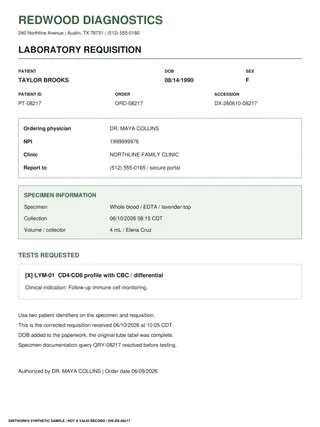
FREE SAMPLE PACK · DIAGNOSTICS
Try it with the free Diagnostics sample pack.
Fictional documents, clean and degraded, with the expected value and position of selected populated fields.
10 PDFs · Patient registration, Lab requisition, Physician authorization and more · JSON and bounding boxes · CC BY 4.0
Free sample · No call required · No platform account
Need larger volumes, your own layouts or other formats? Talk to us ↗
Why “anonymised” claims fail
- Re-identification by linkage. Research has repeatedly shown that a few quasi-identifiers, such as postcode, date of birth and sex, single out most people. Joined with a voter roll, a social profile or a leaked dataset, a "nameless" record becomes a named one.
- Consistent codes. Replacing a name with the same token everywhere keeps records linkable. That is pseudonymisation, and its strength depends on who can reach the mapping and the other fields.
- Free text. Notes, emails and comments carry identifiers that column-based methods never see: "the patient's daughter teaches at the village school", a nickname, an unusual event.
- Document images. Cleaning the extracted text leaves the page image untouched. Names stay visible in letterheads, stamps, signatures, handwriting, barcodes and photos, and in PDF metadata, comments and earlier revisions. The what is redaction guide covers each layer.
- Outliers and small numbers. The only 97-year-old in a district, or a count of two, identifies people even after generalisation.
- Time. New public datasets and better tools lower the cost of linking, so a dataset that was anonymous when released may not stay that way. Recital 26 explicitly asks you to consider technological developments.
Anonymising documents, scans and PDFs
For documents, anonymisation is a process with checks, not a single tool run:
- Remove direct identifiers from every layer: the text layer, the page image (pixels), any hidden OCR text, form fields, annotations and metadata.
- Treat quasi-identifiers and free text deliberately. Generalise or remove dates, places, job titles and rare details, and read the narrative fields.
- Decide whether replacements stay linkable. Consistent synthetic substitutes keep a document set useful for testing but leave it pseudonymised while the mapping, or the original files, exist.
- Assess residual risk for the intended recipient and record the reasoning, then re-check when the data or the recipient changes.
Masking and tokenization are compared in the data masking vs tokenization guide, and categories of anonymization tool in data anonymization tools.
GritRedact detects and permanently removes or replaces PII and PHI in documents, images and audio, with human review before removal and an audit record. Its output is redacted or pseudonymised data; whether it is also anonymous depends on what remains and who receives it. Often the simpler answer is not to use real records at all: GritRender generates fictional documents with known values, and the free diagnostics sample pack shows the idea. The packs are a testing resource, not a free tier.
Not legal advice
Not legal advice. This is an educational summary prepared by GritWorks, a software company, not a law firm. Whether a dataset is anonymous depends on its content, the means available to identify people and the recipient; confirm with your data protection officer or counsel.
What GritWorks does not replace
- GritWorks complements authorization, governance and e-discovery tools rather than replacing them. Access control, data catalogues, retention policy and legal review platforms keep their jobs; GritWorks prepares the documents, images and audio that move between them.
- Redaction is not authorization. If a person or system is not entitled to a record, block access instead of sending a redacted copy.
- Automated redaction alone is not a declaration of HIPAA de-identification. HIPAA recognizes the Safe Harbor and Expert Determination methods; policies, validation and human review must match the intended use and recipient.
- PII flagging is not redaction. GritTransform can flag potentially sensitive values in extracted results, but that does not remove them from the source. Use GritRedact when content must be removed.
- Engagement is sales-assisted. GritWorks has no public or self-serve API, SDK, MCP server or free tier, and publishes no price list: pricing is agreed with sales. Customer APIs are provided after onboarding.
Common questions
What does digitally anonymised mean?
It means personal data held electronically has been processed so that the person it described can no longer be identified, by any means reasonably likely to be used, including by combining it with other data. If a key or other data can link it back to the person, it is not anonymised.
What does anonymization mean?
Anonymization (or anonymisation) means irreversibly transforming personal data so that it no longer relates to an identifiable person. It is an outcome that has to be tested, not a single technique: removing names alone rarely achieves it.
What is the difference between anonymisation and pseudonymisation?
Pseudonymisation replaces identifiers with codes while a key or mapping is kept separately, so the data can be linked back to people and stays personal data under the GDPR. Anonymisation removes that possibility altogether, so anonymous data falls outside the GDPR.
What is k-anonymity?
k-anonymity is a privacy model in which every record shares its combination of quasi-identifiers, such as age band, area and sex, with at least k minus 1 other records. It is reached by generalising and suppressing values, and is often combined with l-diversity so each group also holds varied sensitive values.
Is masked or redacted data anonymous?
Not automatically. Masking and redaction are techniques. The result is anonymous only if what remains, including dates, free text, images and metadata, can no longer identify anyone by reasonably likely means. Often it is pseudonymised or simply redacted personal data.
Does the GDPR apply to anonymised data?
No. Recital 26 says data protection principles do not apply to anonymous information. They do apply to pseudonymised data that could be attributed to a person with additional information, and to the process of anonymising personal data itself.
Is this page legal advice?
No. It is an educational summary prepared by GritWorks, a software company, not a law firm. Confirm whether your data is anonymous with your data protection officer or counsel.
FREE SAMPLE PACK · DIAGNOSTICS
Try it with the free Diagnostics sample pack.
Fictional documents, clean and degraded, with the expected value and position of selected populated fields.
10 PDFs · Patient registration, Lab requisition, Physician authorization and more · JSON and bounding boxes · CC BY 4.0
Free sample · No call required · No platform account
Need larger volumes, your own layouts or other formats? Talk to us ↗
