What data masking is: static vs dynamic data masking
Data masking hides real values behind substitutes that look and behave like the real thing. Common techniques:
- Substitution with realistic fictional values (names, addresses, card numbers that pass format checks).
- Shuffling values between records, nulling them out, or character masking such as showing only the last four digits.
- Date shifting and number variance that keep intervals and distributions roughly intact.
- Deterministic masking, so the same input always gets the same substitute and joins between tables keep working.
Static data masking masks a copy at rest, usually when production data is copied into a non-production environment. The copy never holds the originals. Dynamic data masking leaves stored data untouched and masks it on the way out, according to who is asking. It is an access-control layer: anyone with direct database access, or a query path that bypasses the masking rules, sees real values. Use static masking for copies that leave production; use dynamic masking to limit what authorized users see on screen.
Data masking vs tokenization
Tokenization swaps a sensitive value for a token with no exploitable meaning, such as replacing a card number with a random string of the same length. In vault-based tokenization the mapping lives in a tightly controlled token vault; vaultless tokenization derives tokens with cryptographic keys instead. Either way, an authorized service can turn the token back into the original when a business process needs it, for example to charge a card again.
The practical difference from masking is reversibility. Masked test data does not need to come back, so the originals can stay in production. Tokenized data is designed to come back, so tokenization moves the risk to the vault and to every system allowed to detokenize. Tokenization is widely used to reduce how many systems store card numbers and other identifiers. Under the GDPR, tokenized data is pseudonymised personal data, not anonymous data.
Data masking vs encryption
Encryption protects data from people who do not hold the key: a stolen laptop, an intercepted transfer, a leaked backup. It is not designed to give anyone usable data without revealing the original, because to work with encrypted data an application decrypts it, and then the real values are in front of it.
That is why encryption complements masking rather than replacing it. Encrypt production data at rest and in transit; mask or synthesize the copies that developers, testers, analysts and vendors use. Ordinary ciphertext also changes the format and length of a value, which breaks test systems that expect, say, a 16-digit number. Format-preserving encryption keeps the shape but is still reversible with the key.
Data redaction vs data masking, and data anonymization vs data masking
Redaction removes content; masking replaces it. A redacted document shows a black box or a [REDACTED] label where a value was, and the value is gone from the file. A masked document shows a substitute, which keeps forms, tables and extraction tests realistic. Both should leave the original unrecoverable from the shared output; the what is redaction guide explains why a box drawn over text is neither.
Anonymization is not a technique but an outcome: no one can be identified from what remains, even by combining it with other data. Masking is one technique that can contribute to it, but masked data is often still personal data, because other fields, consistent substitutes or the unmasked source can link it back. The digitally anonymised guide covers the test and k-anonymity.
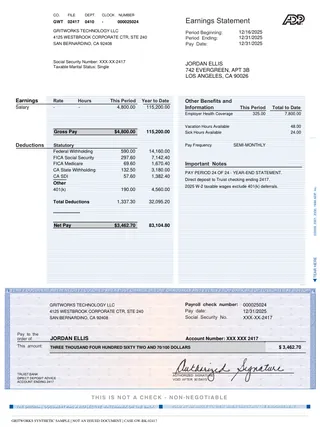
FREE SAMPLE PACK · BANKING
Try it with the free Banking sample pack.
Fictional documents, clean and degraded, with the expected value and position of selected populated fields.
10 PDFs · Checking statement, Paystub, W-2 and more · JSON and bounding boxes · CC BY 4.0
Free sample · No call required · No platform account
Need larger volumes, your own layouts or other formats? Talk to us ↗
Which technique to use when
| Need | Usually the right fit |
|---|
| Developers and testers need realistic data | Static masking, or synthetic data with no real records in it |
|---|
| Support staff should see only the last four digits | Dynamic masking, with access control behind it |
|---|
| A payment system must use the real card number again later | Tokenization |
|---|
| Protect databases, backups and transfers from theft | Encryption |
|---|
| Share a document with some content removed | Redaction (or masking with substitutes, if layout must stay realistic) |
|---|
| Release data so it is no longer personal data | Anonymization, with a documented re-identification risk assessment |
|---|
The techniques combine: an organization might encrypt production, tokenize card numbers, dynamically mask support screens and statically mask its test copies.
Masking and tokenizing documents and PDFs
Most masking and tokenization tools work on database columns, where every value has a known type and location. Documents do not. Names, account numbers and dates sit in free text, tables, headers, stamps, handwriting and barcodes; scanned PDFs hold them as pixels; and the same value can appear in the text layer, a hidden OCR layer and the metadata at once.
- Detect values on the page, not in a schema. That means OCR, layout analysis and entity detection, with human review for what models miss.
- Change every layer. Replace or remove the text, overwrite the pixels and clean the metadata, or the original survives.
- Keep substitutes consistent across files when the documents will be used together, so the same customer gets the same fictional name in every file.
- Tokens rarely suit documents. A string like TKN_8f3a in place of a name breaks layout and makes OCR and extraction tests unrealistic. Realistic substitutes or removal usually work better.
GritRedact masks or replaces values in documents, images and audio according to your policy, including synthetic replacements, and its pixel-level redaction permanently removes approved content, with human review and an audit record. For test corpora that need no real records at all, GritRender generates fictional documents with known values; the free banking sample pack shows what that looks like and is a testing resource, not a free tier. Categories of masking tool are compared in data masking tools.
Not legal advice
Not legal advice. This is an educational summary prepared by GritWorks, a software company, not a law firm. Which technique satisfies a law, standard or contract depends on your facts; confirm with your privacy, security or compliance team.
What GritWorks does not replace
- GritWorks complements authorization, governance and e-discovery tools rather than replacing them. Access control, data catalogues, retention policy and legal review platforms keep their jobs; GritWorks prepares the documents, images and audio that move between them.
- Redaction is not authorization. If a person or system is not entitled to a record, block access instead of sending a redacted copy.
- Automated redaction alone is not a declaration of HIPAA de-identification. HIPAA recognizes the Safe Harbor and Expert Determination methods; policies, validation and human review must match the intended use and recipient.
- PII flagging is not redaction. GritTransform can flag potentially sensitive values in extracted results, but that does not remove them from the source. Use GritRedact when content must be removed.
- Engagement is sales-assisted. GritWorks has no public or self-serve API, SDK, MCP server or free tier, and publishes no price list: pricing is agreed with sales. Customer APIs are provided after onboarding.
Common questions
What is the difference between data masking and tokenization?
Data masking replaces sensitive values with fictional ones, usually permanently, so the masked copy cannot give the originals back. Tokenization replaces values with tokens and keeps a protected mapping, so authorized systems can recover the originals when a process needs them.
Is tokenization more secure than masking?
Neither is more secure in general; they solve different problems. Masked copies cannot be reversed, which suits testing and analytics. Tokenization is reversible by design, so its security depends on protecting the vault or keys and limiting which systems may detokenize.
What is the difference between data masking and encryption?
Encryption protects data from anyone without the key, but authorized users decrypt it and see real values. Masking gives people usable substitutes so they never see the real values. Encryption suits storage and transfer; masking suits non-production copies.
What is the difference between data redaction and data masking?
Redaction removes content from a document, image or recording, usually leaving a box or label. Masking replaces it with a substitute such as asterisks or a fictional value. Both should leave the original unrecoverable from the shared output.
What is the difference between data anonymization and data masking?
Masking is a technique that hides or replaces values. Anonymization is an outcome: no one can be identified from the data by reasonably likely means. Masked data can still be personal data if other fields or the source can link it back to people.
What is the difference between static and dynamic data masking?
Static data masking permanently masks a copy of the data, typically for non-production use. Dynamic data masking leaves stored data unchanged and hides values at query time depending on the user, so privileged users and direct database access still see the originals.
Is this page legal advice?
No. It is an educational summary prepared by GritWorks, a software company, not a law firm. Confirm which technique your obligations require with your privacy, security or compliance team.
FREE SAMPLE PACK · BANKING
Try it with the free Banking sample pack.
Fictional documents, clean and degraded, with the expected value and position of selected populated fields.
10 PDFs · Checking statement, Paystub, W-2 and more · JSON and bounding boxes · CC BY 4.0
Free sample · No call required · No platform account
Need larger volumes, your own layouts or other formats? Talk to us ↗
