THE SHORT ANSWER
Artificial data, usually called synthetic data, is generated by rules, simulations or models instead of being collected from real people or events. It includes tabular records, text, documents, images and audio. It helps when real data is scarce, sensitive or unlabelled, but it inherits its generator's biases, so evaluate models on a held-out set of real data.
How this page was written. GritWorks makes GritRedact, GritTransform and GritRender, so we are not neutral. What we say about other products reflects their own public websites and documentation as of 21 November 2026. We make no claims about other products' accuracy. Products change: confirm details with each vendor.
What artificial data is
Artificial data is data produced by a process rather than observed. The term is used interchangeably with synthetic data. Related terms:
- Augmented data is real data altered, for example a scan rotated, blurred or re-lit, or a sentence paraphrased. It keeps a real source underneath.
- Mock data is placeholder values that let code run, with little attempt at realism.
- Simulated data comes from a model of a process, such as traffic or sensor readings, and is common in engineering.
Generators range from hand-written rules and templates to statistical models fitted to real data and generative AI models.
Types of artificial data
- Tabular. Rows and records for databases, analytics and testing, with relationships between tables kept intact.
- Text. Messages, notes, transcripts and question-answer pairs, often used to train or evaluate language models.
- Documents and images. Forms, statements, invoices, identity specimens and scans, with clean and degraded versions of the same page and the values and positions of fields recorded. See the document types, such as invoice OCR test data.
- Audio. Synthetic voices and calls across accents, noise and channel conditions.
When artificial data helps
- Real data is sensitive. Testing and development can run on fictional records and documents instead of copies of customer data.
- Real data is scarce. New products, rare document layouts, unusual languages and failure cases can be generated before they appear in production.
- Labels are expensive. Generated data arrives with its answers, so extraction and models can be scored field by field. The synthetic test data generation guide covers planning that coverage.
- You need controlled experiments. Hold the content fixed and change one condition, such as blur or skew, to measure its effect alone, as the Docling degraded-scan benchmark does with matched clean and degraded scans.
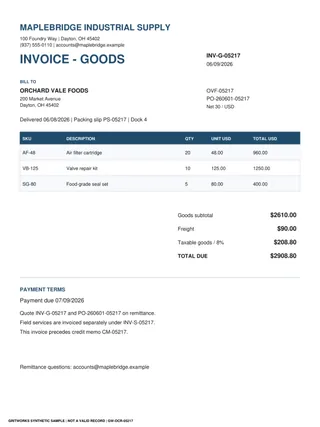
FREE SAMPLE PACK · OCR
Try it with the free OCR sample pack.
Fictional documents, clean and degraded, with the expected value and position of selected populated fields.
10 PDFs · Purchase order, Goods invoice, Services invoice and more · JSON and bounding boxes · CC BY 4.0
Free sample · No call required · No platform account
Need larger volumes, your own layouts or other formats? Talk to us ↗
The limits: generator bias, eval contamination and the real held-out set
- Generator bias. Artificial data reflects what its rules or model know. Layouts, names, phrasings and errors the generator never produces will be missing, and a model trained on it will be weak exactly there.
- Too clean. Generated values are often more regular than reality. Without deliberate noise and edge cases, results look better than production will.
- Eval contamination. If training and test data come from the same generator, a model can learn the generator's habits and score well without learning the task. Keep evaluation data from a different source, or at least a different generator and seed.
- Keep a real held-out set. Final evaluation should include real data, approved for the purpose and with personal data removed, that no synthetic data was derived from. If results on synthetic and real data diverge, trust the real set.
- Model collapse. Training generative models repeatedly on their own outputs narrows what they produce. Mix in real data and track diversity.
Privacy caveats
- Derived is not automatically anonymous. A model fitted to real records can reproduce rare records closely, and an outlier in the output can point back to a real person.
- Test for leakage. Compare generated records with the source data for near-duplicates before sharing, and consider membership-inference testing for sensitive sources.
- Rule-based data avoids the source question. Data built from rules and fictional values, rather than fitted to real records, has no real person behind it, but must still be clearly marked as fictional.
- Law still applies to the source. Using real personal data to build a generator is itself processing under laws such as the GDPR and India's DPDP Act. This is general information, not legal advice.
Where real documents feed a dataset, remove personal data first; see the PII redaction guide and the PII detection guide.
Free dataset packs and GritRender
- The free document dataset packs are fictional documents, clean and degraded, with structured and bounding-box JSON for selected fields. The packs are a testing resource, not a free tier.
- GritRender generates synthetic documents, images and audio with known values for testing and evaluation. It runs offline in your environment or as sales-assisted SaaS, and pricing is agreed with sales.
- To compare providers, see synthetic document data vendors.
What GritWorks does not replace
- GritWorks complements authorization, governance and e-discovery tools rather than replacing them. Access control, data catalogues, retention policy and legal review platforms keep their jobs; GritWorks prepares the documents, images and audio that move between them.
- Redaction is not authorization. If a person or system is not entitled to a record, block access instead of sending a redacted copy.
- Automated redaction alone is not a declaration of HIPAA de-identification. HIPAA recognizes the Safe Harbor and Expert Determination methods; policies, validation and human review must match the intended use and recipient.
- PII flagging is not redaction. GritTransform can flag potentially sensitive values in extracted results, but that does not remove them from the source. Use GritRedact when content must be removed.
- Engagement is sales-assisted. GritWorks has no public or self-serve API, SDK, MCP server or free tier, and publishes no price list: pricing is agreed with sales. Customer APIs are provided after onboarding.
Common questions
What is artificial data?
Artificial data, usually called synthetic data, is data generated by rules, simulations or models instead of being collected from real people or events. It includes tabular records, text, documents, images and audio.
Is artificial data the same as synthetic data?
Yes, the terms are used interchangeably. Augmented data is different: it is real data that has been altered, such as a rotated scan or a paraphrased sentence, so a real source remains underneath.
What is the difference between synthetic data and real data?
Synthetic data is generated, comes with its labels and can cover rare cases on purpose, but is limited by its generator. Real data is the ground truth of what systems will see, but is sensitive, unevenly distributed and must be labelled.
Can you train and evaluate AI models only on artificial data?
Training can use a lot of it, but evaluation should not rely on it alone. Models can learn a generator's habits, so keep a held-out set of real data, approved for the purpose, for final evaluation.
Is synthetic data automatically private?
No. Data generated from a model fitted to real records can reproduce rare records closely. Test generated data for near-duplicates of the source. Data built only from rules and fictional values has no real person behind it.
What are the main limits of artificial data?
Generator bias, data that is cleaner than reality, evaluation contamination when training and test data share a generator, model collapse from training on generated output, and privacy leakage when generators are fitted to real records.
FREE SAMPLE PACK · OCR
Try it with the free OCR sample pack.
Fictional documents, clean and degraded, with the expected value and position of selected populated fields.
10 PDFs · Purchase order, Goods invoice, Services invoice and more · JSON and bounding boxes · CC BY 4.0
Free sample · No call required · No platform account
Need larger volumes, your own layouts or other formats? Talk to us ↗
