Removing identifiers is one route: Safe Harbor and Expert Determination
HIPAA recognizes two ways to show that health information is de-identified and so no longer PHI (45 CFR 164.514(b)).
Safe Harbor. Removing the identifiers is one route, and it has a second condition: the covered entity must also have no actual knowledge that the remaining information could identify the person, alone or in combination with other information. A rare diagnosis, an unusual job or a detail in a free-text note can still point to someone after all 18 identifiers are gone. A covered entity may keep a re-identification code of its own if the code is not derived from information about the person and the way to decode it is not disclosed.
Expert Determination is the other route. A person with appropriate statistical and scientific knowledge determines that the risk that the anticipated recipient could identify anyone is very small, and documents the methods and results. It can keep data that Safe Harbor removes, such as dates or finer geography, when the analysis supports it.
Redaction alone is not HIPAA de-identification. Removing values from a document is a technique. De-identification is an outcome that one of the two methods has to establish, with policies and validation that fit the intended use and recipient. For the wider difference between PHI and PII, see the PHI vs PII guide; for anonymisation outside HIPAA, the digitally anonymised guide.
PHI examples and PII examples
PII examples (information that identifies a person anywhere): name, home address, date of birth, phone number, email address, Social Security number, passport or driver's licence number, bank and card account numbers, IP address, fingerprints, voice recordings and photos of a face.
PHI examples (identifiable health, care or payment information held by a HIPAA covered entity or business associate): a lab report with the patient's name, a claim form with a member ID and diagnosis codes, a discharge summary, an appointment schedule, a prescription record, a hospital bill, a radiology image with the medical record number in its header.
| Example | PHI, PII or neither? |
|---|
| Patient name and date of birth on a lab report held by the laboratory | PHI, and also PII |
|---|
| Member ID and diagnosis codes on a claim held by a health plan | PHI, and also PII |
|---|
| Social Security number on a loan application held by a bank | PII, not PHI: a bank is not a covered entity for that record |
|---|
| A sick note in the HR file of a hospital acting as employer | PII; excluded from PHI as an employment record |
|---|
| Heart rate in a consumer fitness app that is not a covered entity or business associate | Usually PII outside HIPAA; other laws may apply |
|---|
| Diagnosis counts by state with all 18 identifiers removed and no actual knowledge of identifiability | Neither: de-identified under Safe Harbor |
|---|
Where identifiers hide in documents
- Headers and footers. Fax headers print the sender's number, a date and time and sometimes a name on every page. Many records repeat the patient name and record number in each page footer.
- Stamps. "Received" and "Reviewed" stamps add dates, which are identifiers when they relate to the person's care.
- Handwriting. Margin notes, signatures, initials and corrections are missed by tools that read only typed text.
- Barcodes and QR codes. Specimen labels, wristbands and forms encode record numbers and names that are invisible to text search.
- Images. Copies of ID and insurance cards carry faces, numbers and addresses; clinical photos can show faces or distinctive features.
- Metadata and file names. PDF author and title fields, comments, earlier revisions, image EXIF data and file names such as a patient's surname with a date.
- Free text. Narrative notes mention relatives, employers, places and events that identify the person, which falls under the catch-all identifier and the actual-knowledge condition.
Removing a value means removing it from every layer: the text, the page image, any hidden OCR text and the metadata. The what is redaction guide and the PII redaction guide cover how to do that and how to check it.
FREE SAMPLE PACK · INSURANCE
Try it with the free Insurance sample pack.
Fictional documents, clean and degraded, with the expected value and position of selected populated fields.
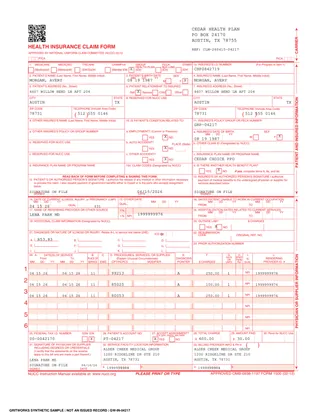
10 PDFs · Premium statement, CMS-1500 claim, Itemized invoice and more · JSON and bounding boxes · CC BY 4.0
Free sample · No call required · No platform account
Need larger volumes, your own layouts or other formats? Talk to us ↗
Testing redaction without real PHI
To test OCR, extraction or redaction against the 18 identifiers, use fictional documents whose values are known in advance, then search the output for every one of them. The free insurance sample pack follows one fictional health-insurance case through claims and statements; it is a testing resource, not a free tier. GritRender generates larger sets with known values.
GritRedact detects and permanently removes PII and PHI from documents, images and audio, with human review before removal and an audit record. Its output still needs a de-identification method and a process that match the intended use.
Not legal advice
Not legal advice. This is an educational summary prepared by GritWorks, a software company, not a law firm. Whether a record is PHI, and whether a dataset is de-identified, depends on your facts; confirm with your privacy officer or counsel.
What GritWorks does not replace
- GritWorks complements authorization, governance and e-discovery tools rather than replacing them. Access control, data catalogues, retention policy and legal review platforms keep their jobs; GritWorks prepares the documents, images and audio that move between them.
- Redaction is not authorization. If a person or system is not entitled to a record, block access instead of sending a redacted copy.
- Automated redaction alone is not a declaration of HIPAA de-identification. HIPAA recognizes the Safe Harbor and Expert Determination methods; policies, validation and human review must match the intended use and recipient.
- PII flagging is not redaction. GritTransform can flag potentially sensitive values in extracted results, but that does not remove them from the source. Use GritRedact when content must be removed.
- Engagement is sales-assisted. GritWorks has no public or self-serve API, SDK, MCP server or free tier, and publishes no price list: pricing is agreed with sales. Customer APIs are provided after onboarding.
Common questions
What are the 18 HIPAA identifiers?
Names; geography smaller than a state; date elements other than the year, and ages over 89; phone and fax numbers; email addresses; Social Security, medical record, health plan beneficiary, account and certificate or license numbers; vehicle and device identifiers; web URLs; IP addresses; biometrics; full-face photos; and any other unique identifying number, characteristic or code.
What are examples of PHI?
A lab report with the patient's name, a claim form with a member ID and diagnosis codes, a discharge summary, a prescription record or a hospital bill, when held by a HIPAA covered entity or business associate. Health information becomes PHI when it identifies the person.
What are examples of PII?
Names, home addresses, dates of birth, phone numbers, email addresses, Social Security numbers, passport and driver's licence numbers, bank and card account numbers, IP addresses, fingerprints, voice recordings and photos of a face: anything that identifies a person alone or in combination.
Is removing the 18 identifiers enough to de-identify data?
Removing them is one route, Safe Harbor, and it also requires that the covered entity has no actual knowledge that what remains could identify the person. Expert Determination is the other route. Redaction alone is not HIPAA de-identification.
Are dates HIPAA identifiers?
Yes. All elements of dates except the year are identifiers when they relate directly to the person, such as birth, admission, discharge and death dates. Ages over 89 are identifiers too and may be grouped as 90 or older.
Is a ZIP code a HIPAA identifier?
Yes. Under Safe Harbor only the first three digits may stay, and only if all ZIP codes sharing them hold more than 20,000 people according to current Census data; otherwise those digits are changed to 000.
Is this page legal advice?
No. It is an educational summary prepared by GritWorks, a software company, not a law firm. Confirm how HIPAA applies to your records with your privacy officer or counsel.
FREE SAMPLE PACK · INSURANCE
Try it with the free Insurance sample pack.
Fictional documents, clean and degraded, with the expected value and position of selected populated fields.
10 PDFs · Premium statement, CMS-1500 claim, Itemized invoice and more · JSON and bounding boxes · CC BY 4.0
Free sample · No call required · No platform account
Need larger volumes, your own layouts or other formats? Talk to us ↗